Playable Ads Trends in Mobile Games & Apps – July 2026

Helping you stay 2.5 steps ahead of the games industry. Don't be too serious, except about UA.
Subscribe to my Brutally Honest newsletter!
As the UA landscape evolves, so do the creative trends that shape how games communicate with their audiences. With the rise of Applovin and increased spend on SDK networks, I’ve decided to bring you a monthly trends review of top-performing playable ads across different genres.
For those that read only summaries, here are playable trends July in a nutshell:
- Everything is a playable mechanic
- The library of playable mechanics keeps growing. Instead of relying on proven templates like pull-the-pin or sorting puzzles, publishers are looking far beyond the mobile gaming world for inspiration. Clash of Clans transforms the classic Tetris formula into a defensive strategy puzzle, showing that recognizable gameplay loops can be successfully adapted to almost any game genre.
- Football is everywhere
- One of the most recognizable playable trends this month comes from outside the gaming industry altogether. Football-inspired mechanics are becoming increasingly common, and publishers are finding creative ways to blend them into genres where they don’t naturally belong. Instead of creating another endless runner or survivor clone, developers are turning football into a familiar interaction layer that makes completely different gameplay feel fresh and instantly understandable.
- One game, dozens of playables
- Games packed with multiple mini-games have a huge advantage in user acquisition – they don’t need to sell the entire app in a single playable. Instead, they can focus on one satisfying mechanic at a time. Better yet, if that mechanic naturally lends itself to a tutorial, you’ve got a recipe for a highly engaging playable. Puzzle Page is a perfect example of this strategy.
Tetris meets tower defense
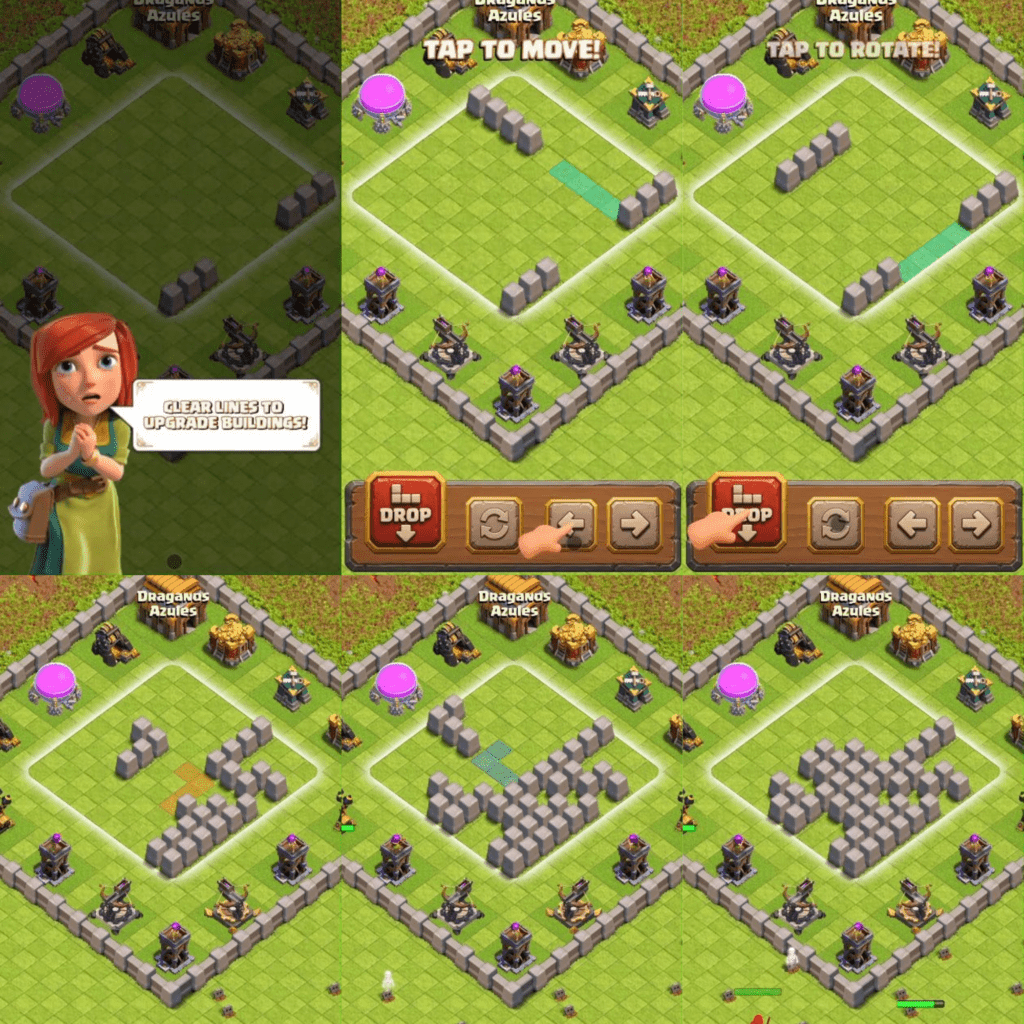
Supercell is no stranger to experimenting with playable ads, but this month they introduced something I haven’t seen before. Instead of showcasing the familiar base-building or combat mechanics of Clash of Clans, they borrowed one of the most iconic gameplay loops in gaming history – Tetris.
The playable opens in a familiar Clash of Clans village under attack. Your defenses are struggling, and the tutorial quickly introduces the core mechanic. Instead of collecting resources in the traditional way, you play a game of Tetris. Players rotate and place wall-shaped blocks onto the board, completing horizontal lines to earn gold. Once the Tetris round ends, the gold is automatically invested into upgrading your village’s defenses before the next enemy wave begins.
What makes this creative particularly clever is how naturally the borrowed mechanic fits into Clash of Clans’ progression system. Tetris isn’t just a mini-game thrown into the playable for attention – it becomes the economy that drives your upgrades. The better you play, the more resources you earn, the stronger your defenses become, and the longer you survive. It’s a surprisingly elegant way to connect two completely different genres.
This also highlights a broader trend I’ve been noticing throughout 2026. Publishers are moving beyond simply adapting their existing gameplay into playable ads. Instead, they’re asking a different question: what gameplay mechanic would be the most engaging in the first 30 seconds? If the answer comes from another genre entirely, they’re no longer afraid to use it.
The biggest advantage of this approach is accessibility. Every gamer immediately understands how Tetris works, which removes the learning curve while still delivering satisfying progression. Rather than spending valuable seconds teaching a new mechanic, Supercell leverages decades of player familiarity and redirects that engagement into Clash of Clans’ upgrade loop.
We’ve seen publishers borrow mechanics from puzzle games, hypercasual hits, and hybrid-casual titles before, but this feels like another step forward. Instead of simply reskinning a proven playable template, Supercell integrated a legendary gameplay mechanic into the game’s own progression system. It’s a great reminder that the best playable ideas don’t always come from your own genre – they can come from anywhere, as long as they make sense within your game’s fantasy.
Zombie Football Survivor
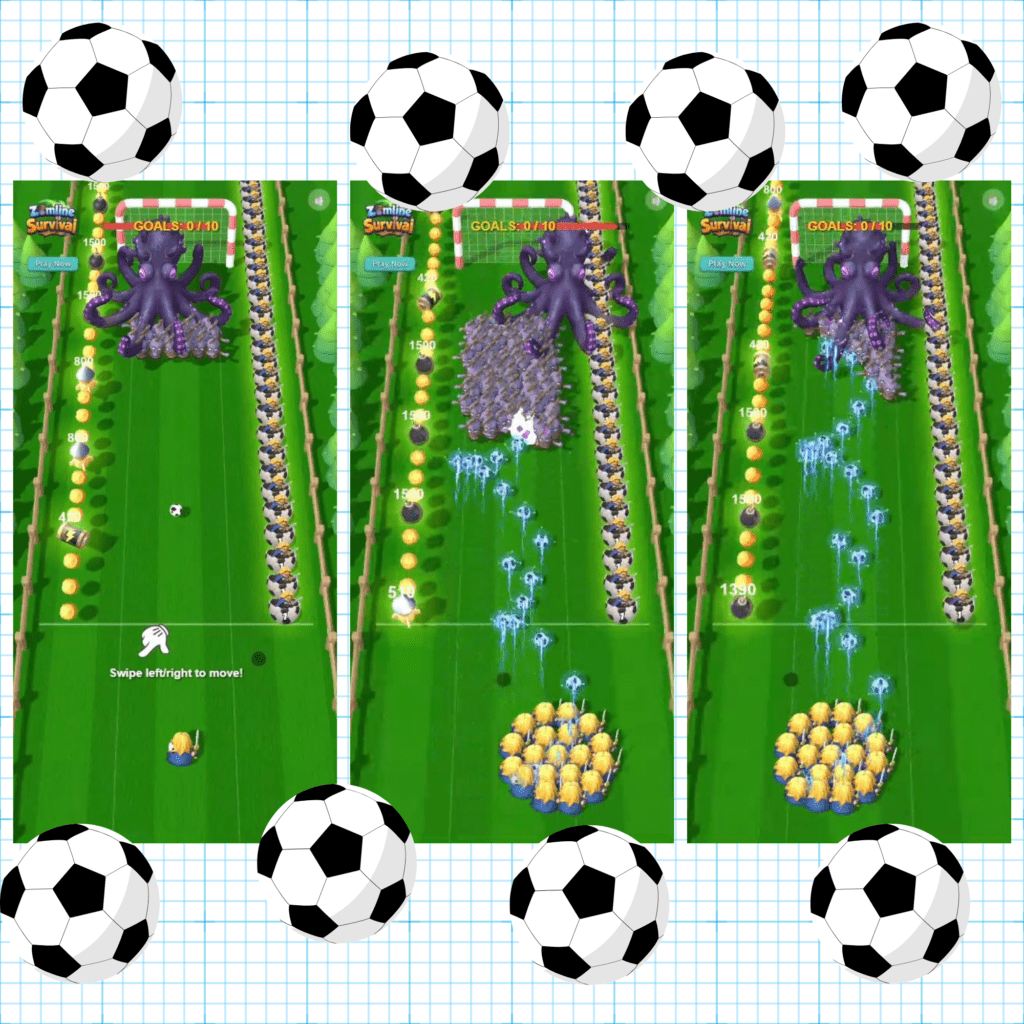
When I first played this playable, I immediately recognized one of the most successful playable mechanics of the past year. The familiar gate system is still there – you move left and right, choosing between upgrades, collecting additional units, and improving your chances of reaching the end of the level.
The difference is how Yoozoo presents it.
Instead of running through floating gates, you’re playing on a football pitch. Every successful choice sends the ball further down the field while recruiting more survivors into your squad. The survivors automatically shoot down incoming zombie waves, eventually facing a giant octopus goalkeeper protecting the goal. Beat the boss, score the goal, and win the match.
What’s clever here is that almost nothing changed mechanically.
Under the hood, this is still the same highly successful gate template we’ve seen countless times in playable ads. Players make quick left-right decisions, choose between different upgrades, build a stronger army, and progress toward a final encounter. The interaction is familiar because it already works.
What Yoozoo changed is the fantasy.
Instead of feeling like another generic runner, the football stadium instantly gives the playable a unique identity. Collecting more survivors now feels like building your football team, progressing down the lane becomes advancing toward the opponent’s goal, and the final boss transforms into an oversized goalkeeper standing between you and victory.
This is becoming another noticeable trend in playable ads. Publishers aren’t always inventing completely new mechanics – they’re finding smarter ways to package proven ones. A successful template combined with a fresh visual fantasy is often enough to make players feel they’re experiencing something new.
And honestly, that’s exactly what playable ads are about. The interaction only needs to last 30 seconds. If a publisher can take a mechanic that already converts well and give it a memorable theme that stands out in a crowded feed, they’ve already solved half the creative challenge.
Don’t sell the collection, sell the puzzle
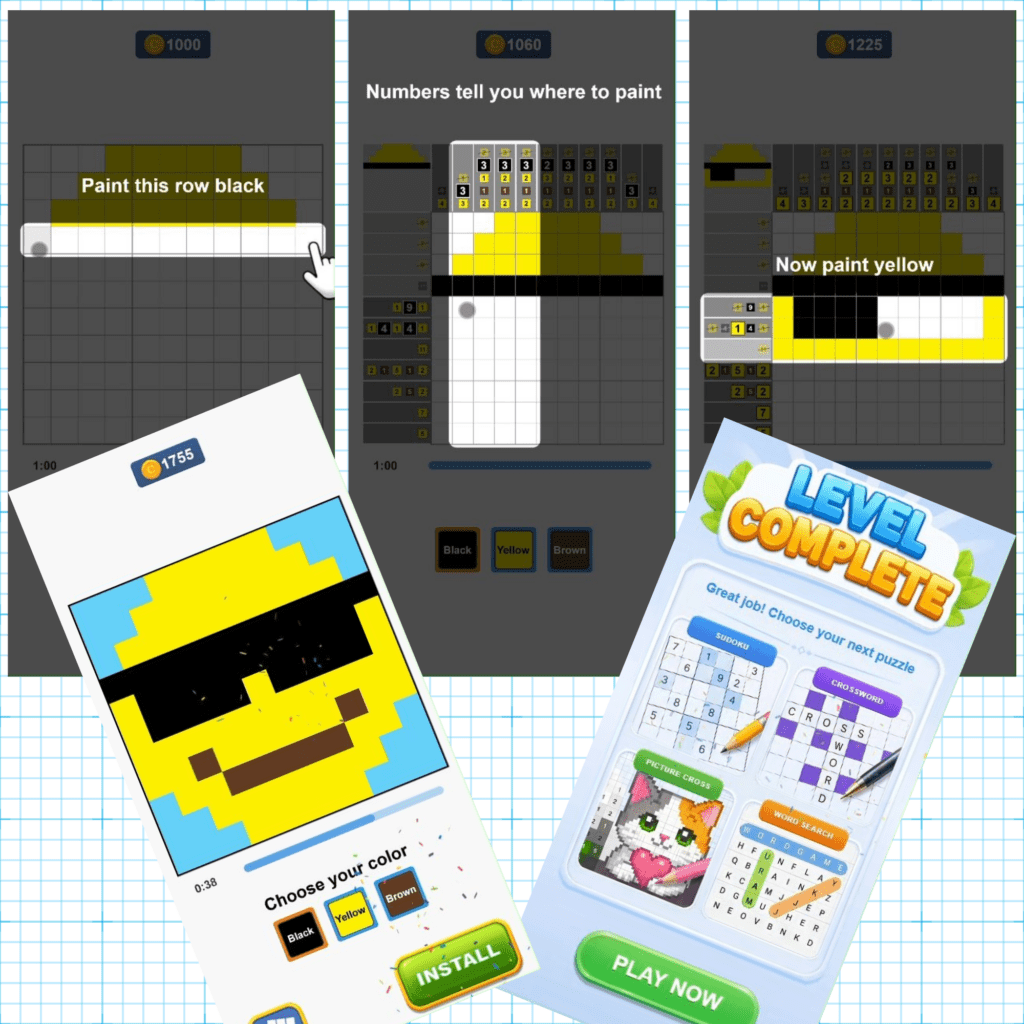
When I first played this playable, I immediately appreciated how simple it was. There was no attempt to explain the entire Puzzle Page app or showcase its huge collection of games. Instead, the playable focuses on a single puzzle: Simple nonogram game.
The experience starts with a guided tutorial. Players learn how the numbered clues work, which color to select, and how to paint the correct rows and columns. Within a few seconds, they’re no longer watching instructions – they’re solving the puzzle themselves.
This is exactly why tutorial playables continue to perform so well. Rather than overwhelming players with options, they teach one interaction at a time, creating a sense of progress almost immediately. By the time the tutorial disappears, the player already understands the mechanic and is invested enough to finish the puzzle.
What makes this strategy particularly effective is the nature of the app itself. Puzzle Page isn’t built around a single gameplay loop – it’s a collection of dozens of different puzzle types. That means the marketing team doesn’t need one playable to represent the entire product. Every puzzle can become its own acquisition funnel.
Nonogram today. Sudoku tomorrow. Crossword next week. Word Search after that.
Instead of forcing one generic creative to do all the work, Puzzle Page can continuously produce fresh playables, each targeting a different audience while promoting the same app. Every mini-game effectively becomes another creative concept.
It’s a strategy I expect more publishers to adopt, especially those with games containing multiple mechanics or game modes. Don’t try to sell everything at once. Pick one mechanic, build a short tutorial around it, and let players experience that moment of satisfaction for themselves. If your app contains ten great mini-games, you don’t have one playable – you potentially have ten just to start with.

Data from PlayableMaker – what is being created?
Our friends at PlayableMaker have shared their latest data and insights for July 2026, revealing trends in templates, game mechanics and ad network usage. Here’s a quick summary:
Did you know that you can now vibecode your playables? Here are some examples we liked last week:
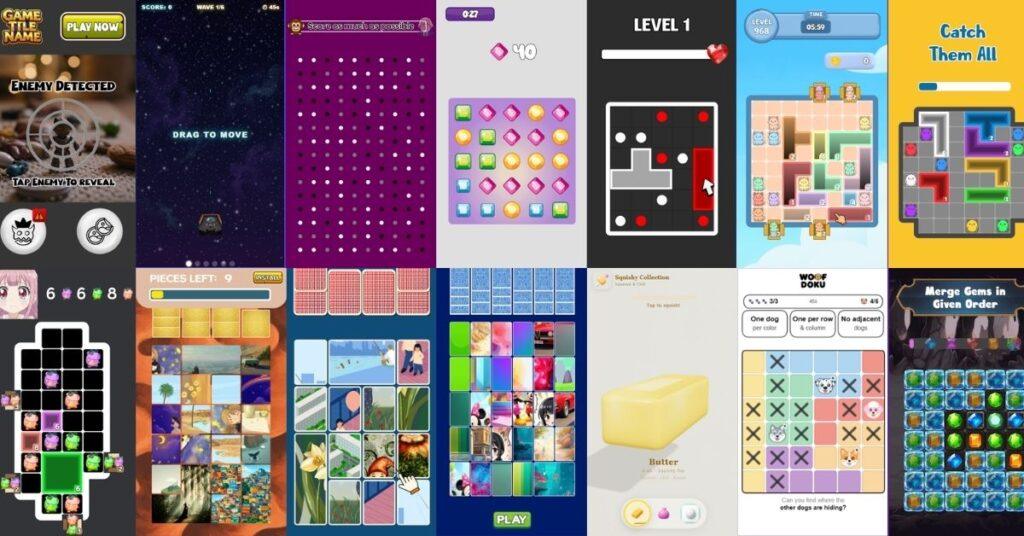
New Popular Templates for July 2026
- Pick Equip Break Win: Pick the tool, equip and get reward
- Merge 3D Unlock Stage: Unlock new stages by merging
- Toy Search and Sticker Book: Find the enemy in video sequence
- Puzzle Solitaire Merge Drop: Dropping cards, solving puzzles
- DogDoku: Sudoku with an animal twist, woof
- Connect Dots: Connect matching dots or items
- Squishy Toys: Anti stress toys and relaxed feeling
Playable Maker modules – which ones are used the most?
- Builder Templates (53%)
- Video Playables (38,9%)
- Vibe Coding (8,1%)
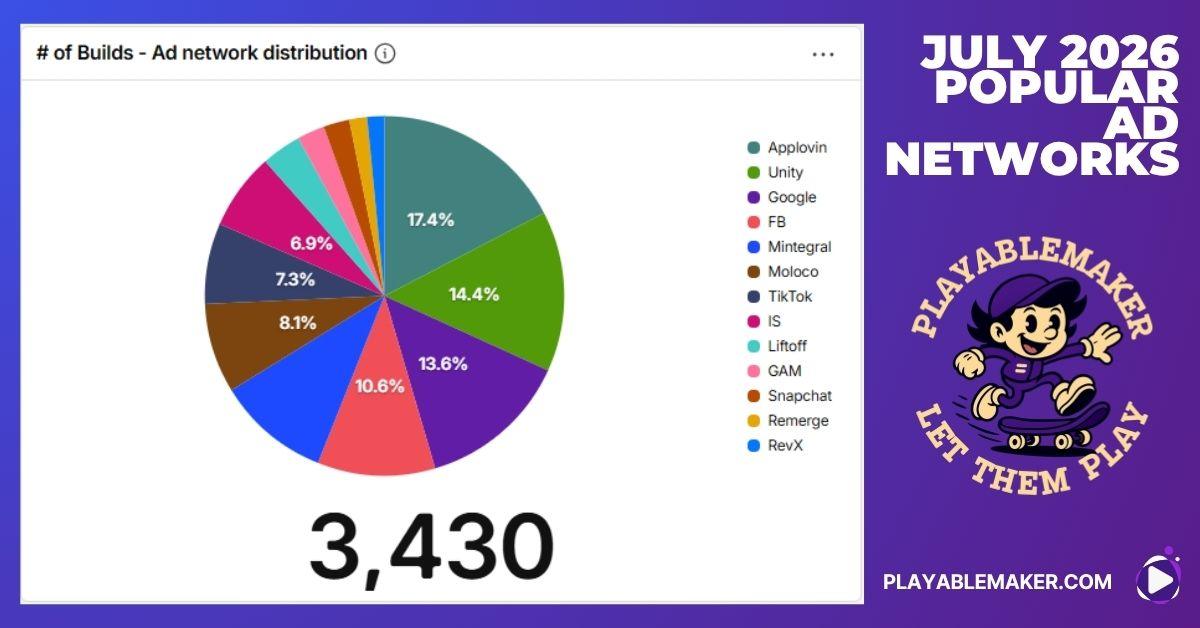
Popular Ad Networks
July 2026 favorite playable creations from our customers:
- https://app.playablemaker.com/share/6a54d7ee3ca1d05965056ce1
- https://app.playablemaker.com/share/6a3e6038f072fae46a2a35af
- https://app.playablemaker.com/share/6a50e7fff072fae46a2df218
- https://app.playablemaker.com/share/6a5e13ad29117323e3304bfe
- https://app.playablemaker.com/share/6a6b433629117323e333090d
Helping you stay 2.5 steps ahead of the games industry. Don't be too serious, except about UA.
Subscribe to my Brutally Honest newsletter!