

Playable Ads Trends in Mobile Games & Apps – September 2026

Helping you stay 2.5 steps ahead of the games industry. Don't be too serious, except about UA.
Subscribe to my Brutally Honest newsletter!
As the UA landscape evolves, so do the creative trends that shape how games communicate with their audiences. With the rise of Applovin and increased spend on SDK networks, I’ve decided to bring you a monthly trends review of top-performing playable ads across different genres.
For those that read only summaries, here are playable trends September in a nutshell:
This month, there was one obvious problem with looking at playable ad trends: there simply wasn’t that much that felt genuinely new. Instead of forcing another list of “10 new playable mechanics,” we decided to look deeper at one publisher and see what happens when you study their creative output at scale.
For this edition, we focused on Voodoo and three of its titles: Last Extract, Loop Sort, and Marble Sort.
- Last Extract: A Dangerous Dave 2 Throwback
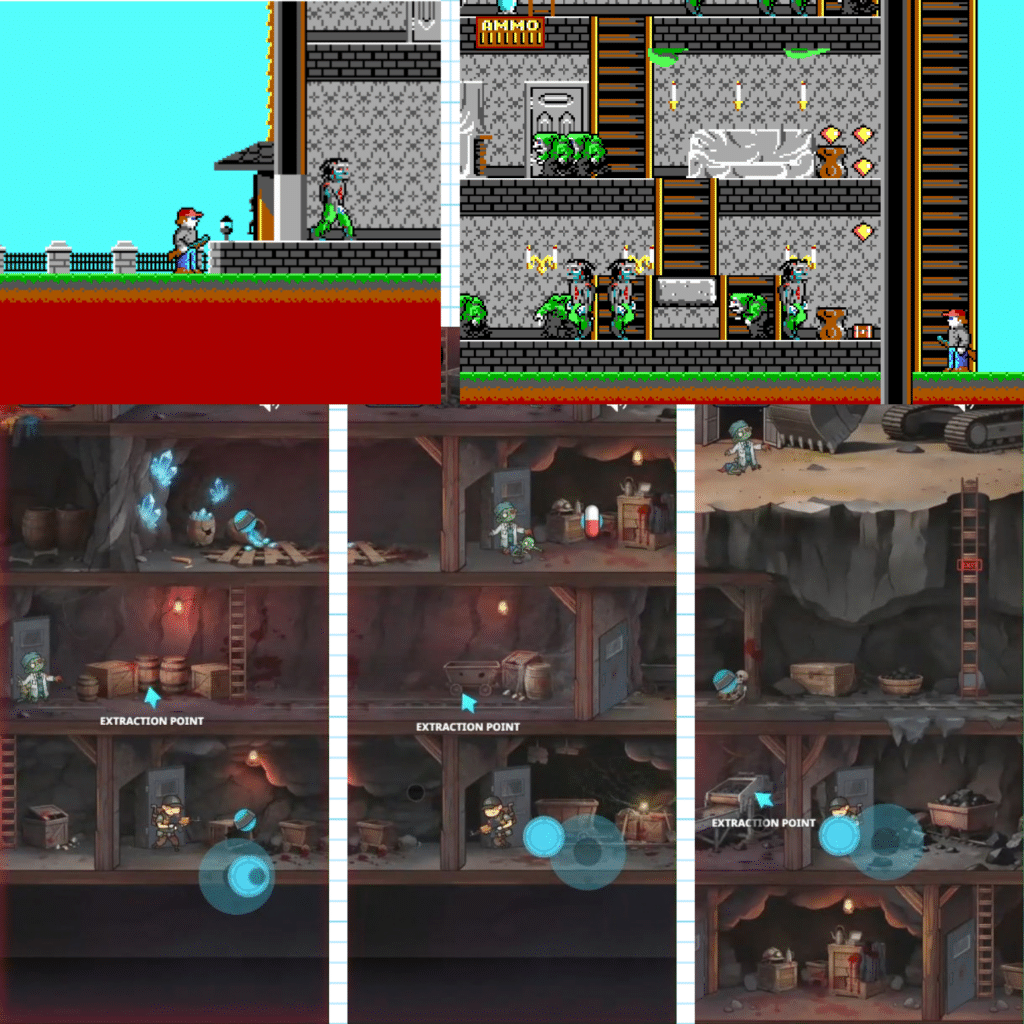
- The first Voodoo title we looked at was Last Extract, and this one immediately triggered a memory of an old-school classic: Dangerous Dave in the Haunted Mansion, also known as Dangerous Dave 2, originally released for DOS in 1991.
- Marble Sort: Simple, But Surprisingly Satisfying
- Marble Sort is a great example of how a very simple mechanic can become much more engaging by adding one extra layer of physical interaction.
- Loop Sort: When a Playable Becomes Too Much of a Loop
- Loop Sort is almost the opposite experience to Marble Sort. While Marble Sort immediately communicates what you are doing and gives you satisfying feedback after every action, Loop Sort left me playing for more than three minutes without really understanding the core mechanic or, more importantly, what I was supposed to do to win.
Last Extract: A Dangerous Dave 2 Throwback
The first Voodoo title we looked at was Last Extract, and this one immediately triggered a memory of an old-school classic: Dangerous Dave in the Haunted Mansion, also known as Dangerous Dave 2, originally released for DOS in 1991.
At first glance, the two games obviously look very different. Last Extract is a modern zombie extraction game set inside a mine, while Dangerous Dave 2 is a 2D platform shooter set in a haunted mansion. But the underlying gameplay structure has some surprisingly familiar elements. In both, the player moves through a multi-level environment, travels between different floors and rooms, deals with enemies positioned around the level, collects useful items and tries to progress further through the environment. Dangerous Dave 2 also lets the player aim and shoot in different directions, including upward and downward, while navigating platforms, stairs and narrow spaces.
Last Extract translates that old formula into a modern playable-ad language. Instead of running horizontally through a mansion, you move vertically through a mine, climbing between floors, fighting enemies, collecting resources and looking for the extraction point. The extraction marker gives you a clear objective, while the changing floors create a sense of exploration and progression.
What makes this particularly interesting is that Last Extract had 509 creatives in September, 37 of which were playables. That’s a substantial amount of creative testing around a single title, and the playable approach fits the game particularly well because its core loop is already easy to demonstrate visually: move through the environment, encounter enemies, collect resources and reach the extraction point.
The ad doesn’t need to explain the entire game. It takes one recognizable slice of the experience and turns it into something immediately interactive. The player gets to navigate the mine, see enemies and resources, and understand the extraction objective within seconds.
And that’s probably the biggest takeaway from Last Extract. You don’t always need a completely new playable mechanic. Sometimes a strong playable comes from identifying the most recognizable structure of the game and making that structure interactive. In this case, Voodoo takes a familiar exploration-and-combat formula, gives it a modern extraction-game setting, and creates something that feels both immediately understandable and surprisingly nostalgic.
Marble Sort: Simple, But Surprisingly Satisfying
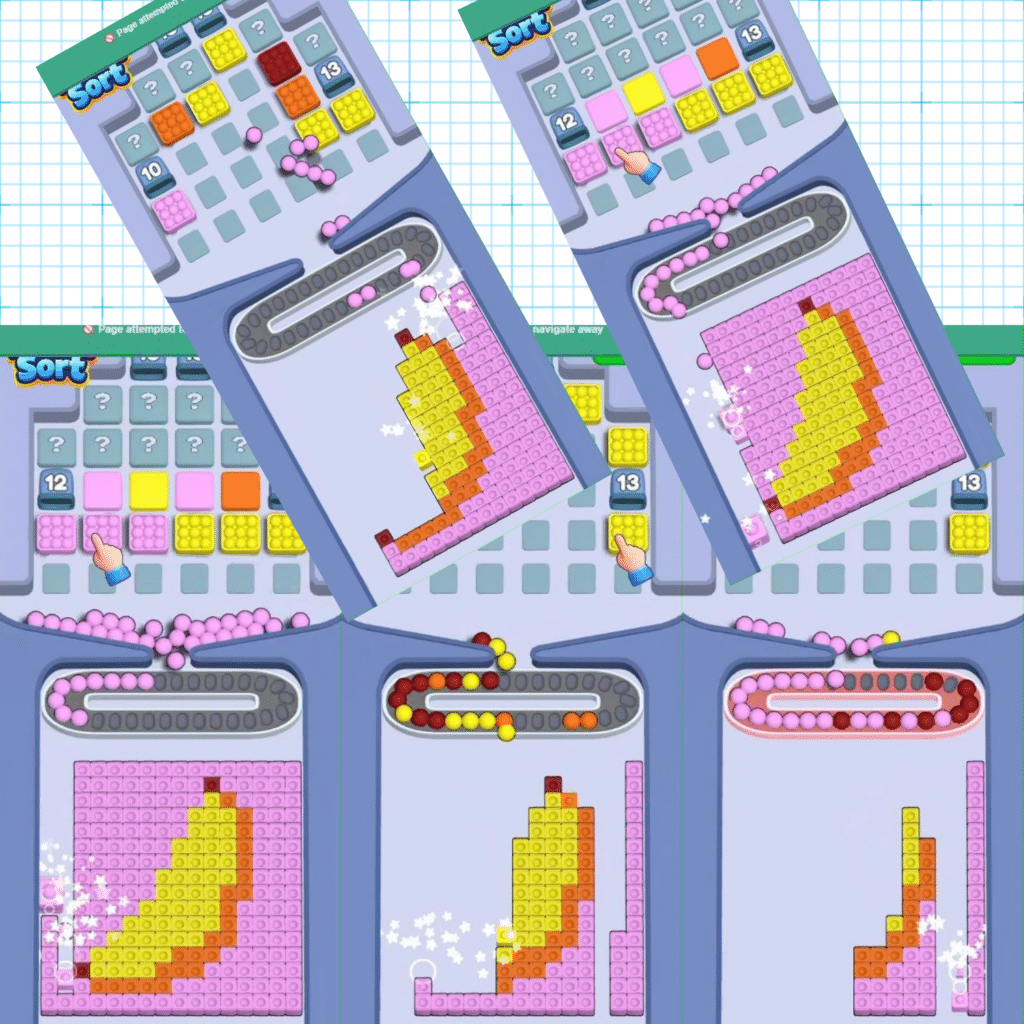
Marble Sort is a great example of how a very simple mechanic can become much more engaging by adding one extra layer of physical interaction.
The basic idea is simple: tap the colored containers to release the marbles and sort them into the right places. But instead of the balls simply disappearing or instantly filling a progress bar, you watch each marble fall, bounce around and get caught in a pinball-like gate before eventually landing on the picture below.
And that’s where the playable gets interesting. The picture isn’t simply revealed as you progress. It gets physically broken apart, piece by piece, ball by ball. Every successful marble contributes to destroying another part of the image, giving the player a constant visual reward for every interaction.
That creates a really satisfying loop: tap → watch the marble fall → see it bounce through the gate → hit the picture → another piece breaks. The player is constantly waiting to see what happens next, rather than simply watching a counter increase.
The numbers also show how aggressively this concept is being tested. Marble Sort generated more than 600 creatives last month, including 57 playables, with AppLovin, Unity and Mintegral taking the biggest share of the playable distribution.
The takeaway is that simple mechanics don’t have to mean simple experiences. Marble Sort takes a familiar sorting mechanic and adds physicality, anticipation and destruction. The player isn’t just sorting balls — they’re watching those balls actively transform the scene, one piece at a time.
Loop Sort: When a Playable Becomes Too Much of a Loop
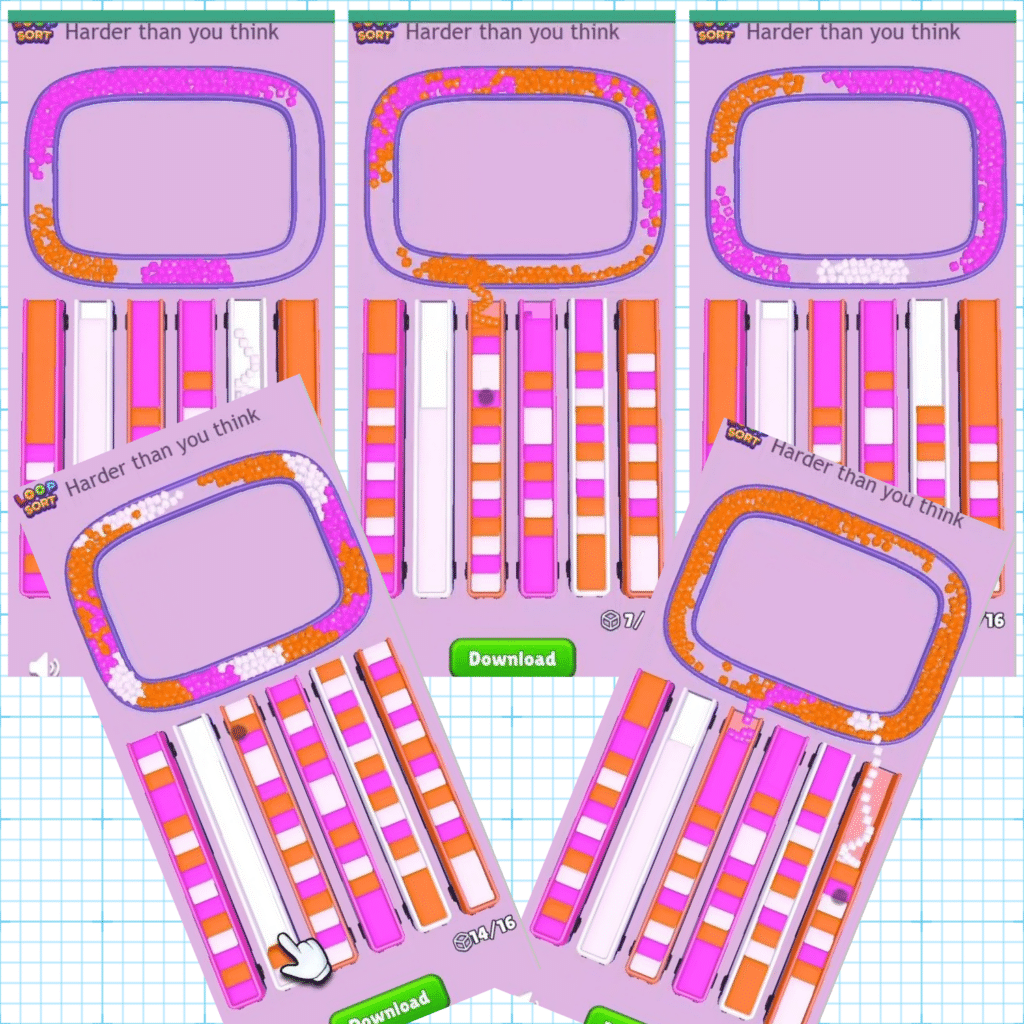
Loop Sort is almost the opposite experience to Marble Sort. While Marble Sort immediately communicates what you are doing and gives you satisfying feedback after every action, Loop Sort left me playing for more than three minutes without really understanding the core mechanic or, more importantly, what I was supposed to do to win.
The playable presents a series of colored tubes and a conveyor-like loop filled with small balls. You tap and move things around, watch the balls travel through the loop and gradually interact with the tubes, but the actual objective remains surprisingly unclear. There is no strong moment where the game teaches you “this is what you need to do” and then lets you execute it.
And that’s a problem because long playables only work when the player understands why they should keep playing. The length itself isn’t necessarily bad. In fact, a three-minute playable can be extremely valuable if every interaction reveals something new, increases the stakes or moves the player closer to a clearly understood goal. Here, the extra time mostly created confusion rather than curiosity.
The scale of testing is still significant. Loop Sort generated 838 creatives in total, including 37 playables, with AppLovin, Unity and Mintegral accounting for the largest share of playable distribution.
This makes Loop Sort an interesting contrast to Marble Sort. Both rely on colorful balls, sorting and satisfying movement, but Marble Sort gives you an immediate cause-and-effect relationship: tap → balls move → picture breaks → progress. Loop Sort has much less obvious feedback about whether your actions are actually moving you toward success.
The takeaway isn’t that long playables don’t work. Quite the opposite. If you can keep someone engaged for three minutes, that’s incredibly valuable. But you need to earn every second. The player should understand the mechanic, understand the objective, and continuously feel that they are getting closer to something. Otherwise, a long playable can simply become a very long tutorial that never quite explains the game.
What Voodoo Does Consistently
Looking across Last Extract, Marble Sort and Loop Sort, there are some clear patterns in how Voodoo approaches playable testing. The games are completely different, but the advertising structure feels surprisingly consistent.
The layout is one of the clearest similarities. All three playables keep a prominent Download / Play Now CTA visible throughout the experience, rather than waiting until the end to introduce the conversion point. The playable is treated as both a game and an ad from the very beginning, with the install action always within reach.
They also share another important characteristic: Voodoo isn’t afraid of long playables. All three give the player enough time and interactions to explore the mechanic rather than delivering a 10–20 second taste. This seems to be part of a broader testing philosophy: if the mechanic can hold attention, let the player keep playing and see how far engagement can go.
There was, however, one particularly frustrating pattern across all three: automatic redirects to the app store. During testing, it happened frequently enough that almost every few interactions could potentially trigger a redirect. From a user perspective, this made the experience quite frustrating and sometimes interrupted the gameplay before you had finished the interaction. But the important observation is that it wasn’t isolated to one title. The same aggressive conversion approach appeared across all three games, suggesting a deliberate testing and monetization setup rather than an individual creative decision.
The distribution strategy was also remarkably consistent. AppLovin, Unity and Mintegral repeatedly appeared as the major networks for these playable creatives, with the titles being tested at a substantial scale. Last Extract had 509 creatives and 37 playables, Marble Sort had 600+ creatives and 57 playables, while Loop Sort reached 838 creatives and 37 playables.
So while the actual gameplay concepts differ, the underlying creative-testing framework looks very similar: high creative volume, a meaningful percentage of playable ads, long interactive experiences, persistent install CTAs, aggressive conversion triggers and testing across the same major ad networks.
For us, that’s perhaps the most interesting finding from looking at three completely different Voodoo games. The creative idea changes, but the testing machine behind it appears much more standardized.

Data from PlayableMaker – what is being created?
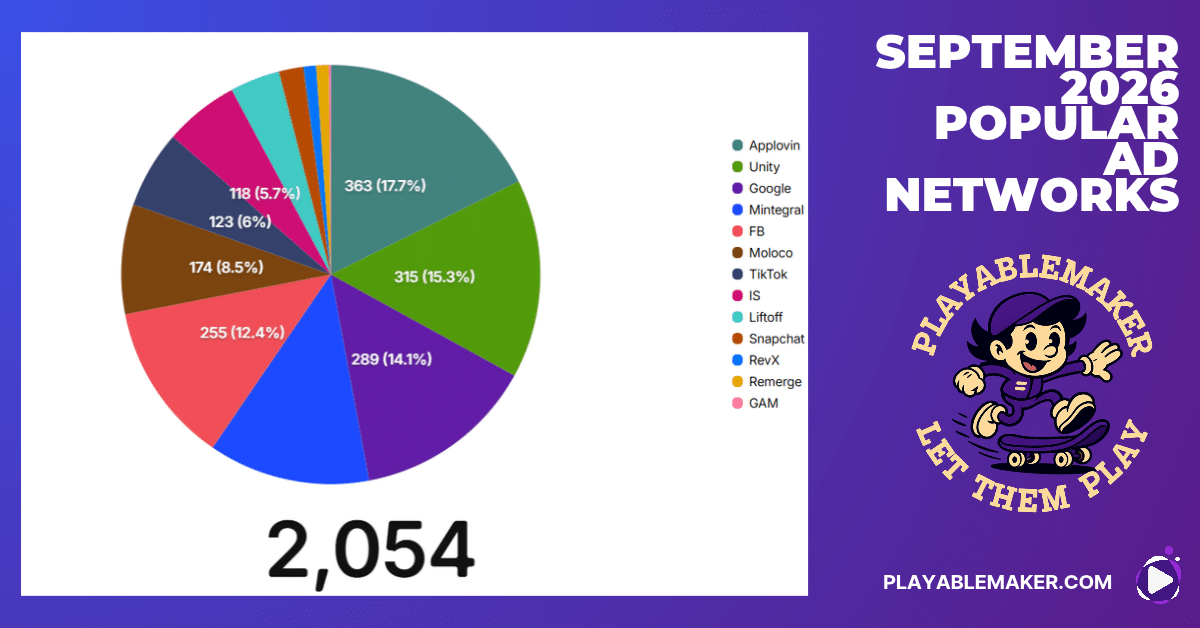
Our friends at PlayableMaker have shared their latest data and insights for September 2026, revealing trends in templates, game mechanics and ad network usage. Here’s a quick summary:
Did you know that you can now vibecode your playables? Here are some examples we liked last week:
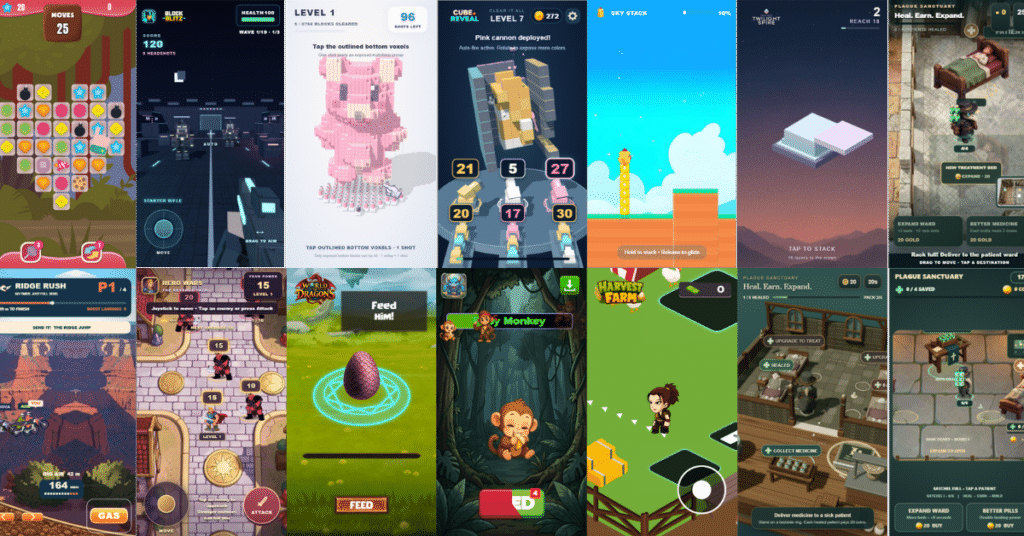
New Popular Templates for September 2026
- Voxel Shoot: Clear the image using cannons below
- Candy Smash: Well known match3 game with usable bonuses
- Dragon Feeding: Choose the egg, feed the dragon, evolve
- Hero Fighter: Choose your enemies, grow and win the game
- Moto Madnes: Motocross madness as you know it
- Harvest Farm: Harvest, upgrade, gather, sell…
- Feed And Grow: Feed the character and watch it grow!
Playable Maker modules – which ones are used the most?
- Builder Templates (51.6%)
- Video Playables (41.5%)
- Vibe Coding (6.9%)
Popular Ad Networks
September 2026 favorite playable creations from our customers:
- https://app.playablemaker.com/share/6a857d8a29117323e338883d
- https://app.playablemaker.com/share/6a96da3729117323e33bff6e
- https://app.playablemaker.com/share/6a993c3429117323e35a5826
- https://app.playablemaker.com/share/6aa133ae29117323e35bda73
- https://app.playablemaker.com/share/69ef5cde65016a19bed87ef4
Helping you stay 2.5 steps ahead of the games industry. Don't be too serious, except about UA.
Subscribe to my Brutally Honest newsletter!